
Counseling Programs at Northwestern University
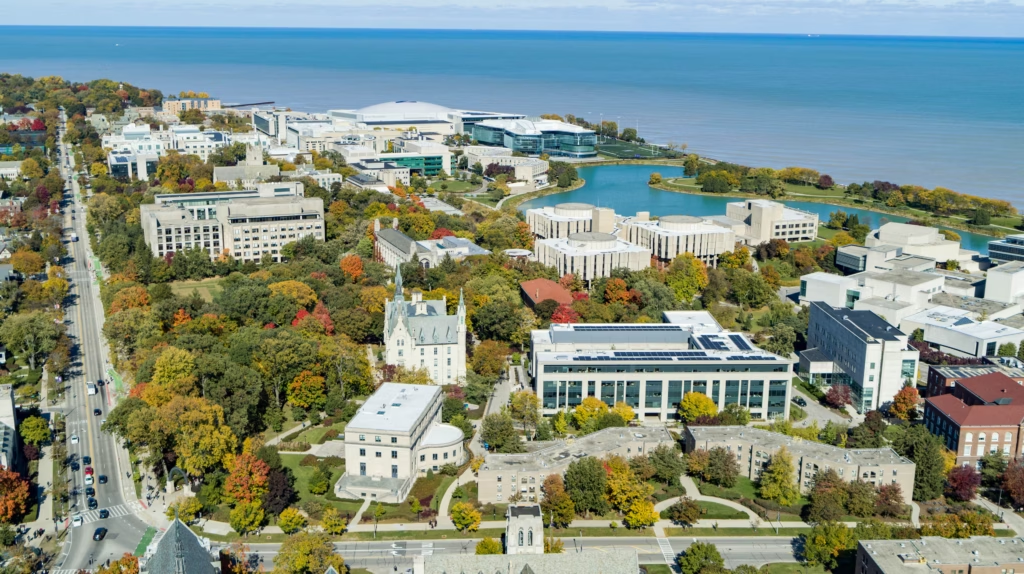
Northwestern University’s Master of Arts in Counseling program through The Family Institute prepares tomorrow’s counseling leaders. This CACREP-accredited curriculum combines rigorous academic standards with detailed clinical training through several pillars of excellence.
The program builds on a strong psychodynamic foundation. Students learn to explore forces beyond awareness that shape identity and experiences. This lens helps clients break free from their past and create more enriching, authentic lives in the present. Students develop cognitive complexity in clinical judgments while building multicultural awareness that welcomes diversity, equity, and social justice values.
Northwestern offers flexible program options that match your background and lifestyle. Students can choose from accelerated, traditional, and part-time tracks, available both on-ground and online. The Bridge to Counseling Program helps newcomers get prerequisite coursework in clinical interviewing and practice. This builds essential skills before moving forward. Students interested in working with youth can pursue a Child and Adolescent Specialization while staying fully prepared to counsel adults.
The foundation of Northwestern’s counseling education comes from its detailed immersion in clinical work and focus on developing reflective practices. Each course fits within the context of ethics, multiculturalism, lifespan development, advocacy, and evidence-based practice. This hands-on model challenges students to reflect on their identity and its impact on their counseling approach.
Students get opportunities to build close relationships with faculty, supervisors, preceptors, therapists, and researchers who create new paths in scholarship, education, and clinical practice. These experienced counselor educators and supervisors teach, mentor, and guide students throughout their learning experience.
Graduates receive a Master of Arts degree from Northwestern University and become license-eligible in the United States. Those seeking licensure just need additional clinical experience and supervision before qualifying for the licensing exam, typically taking two years. The program’s CACREP accreditation creates a solid foundation for independent practice licensure in most states.
Mental health-related occupations will grow exponentially between now and 2033. Northwestern’s counseling program prepares you to meet this growth with expertise, compassion, and evidence-based strategies.
What counseling programs does Northwestern offer?
Northwestern University offers a Master of Arts in Counseling through two main paths that match your educational background. You can choose from accelerated, traditional, and part-time formats to fit your schedule and priorities.
The Standard Program needs you to complete 24 graduate-level courses, a Practicum, and an Internship. Students with an undergraduate degree in psychology or related fields will find this path suitable. The Bridge to Counseling Program helps professionals switching careers by providing three starter courses in the first quarter. These courses prepare you for graduate-level concepts before you join the Standard Program curriculum.
You can earn your master’s degree in just 18 months on either path, based on your chosen schedule. Both programs give you 800 hours of clinical training through practicum and internship experiences. This hands-on training helps you develop real-life skills under professional supervision.
Students can focus on the Child and Adolescent Specialization. This option meets the growing demand for youth mental health services, as 13-20 percent of children in the United States experience a mental disorder annually. The specialization has five focused courses:
- Human Growth and Development (Child and Adolescent Focus)
- Child and Adolescent Counseling and Psychotherapy
- Assessment in Counseling (Child/Adolescent)
- Evaluation and Treatment of Trauma (Child/Adolescent)
- Play Therapy Methods
You’ll still be fully prepared to work with adults in professional counseling settings after completing this specialization.
The program combines theory with practical skills. Core courses cover psychodynamic counseling, group dynamics, psychopathology, assessment techniques, career development, and substance abuse treatment. Students develop reflective practices and get complete clinical immersion experiences throughout their studies.
Graduates receive an accredited Master of Arts degree from Northwestern University and become license-eligible throughout the United States. The program’s CACREP accreditation (Council for Accreditation of Counseling and Related Educational Programs) is recognized by the Council for Higher Education Accreditation (CHEA). This recognition meets the educational requirements for counseling licensure in most states.
Internships/Practicum at Northwestern
Clinical experience at Northwestern’s counseling program is its backbone. Students complete a Practicum and an Internship that add up to 800 hours of supervised real-life skill development. This complete training helps build clinical abilities gradually as students work toward their degree.
The 200-hour Practicum introduces professional counseling duties. Students need to spend 6-16 hours weekly at their placement site. They must complete 50 hours of direct face-to-face client contact. This typically means 1-3 hours weekly with adult clients who have mild mental health concerns. The Practicum runs through three consecutive terms while students take Supervised Practicum in Counseling courses to prepare for direct clinical services.
The 600-hour Internship follows as an advanced clinical experience. Students take on all counselor roles while providing supervised counseling to clients. This placement needs 16-32 hours weekly, with 240 hours of direct client contact—about 8-10 hours per week. Students also learn advanced client management and therapeutic skills through the Supervised Internship in Counseling course.
Supervision plays a key role in both placements. Practicum students have weekly one-hour meetings with their site supervisor. They also attend two-hour Reflective Practitioner Supervision meetings with their university supervisor and a small student group. The Internship has a similar structure with weekly one-hour site supervisor meetings and two-hour Case Conference Supervision sessions.
Program track determines the placement timeline. Accelerated Standard Program students start field placement in their first quarter. Traditional Standard Program students begin in their fourth quarter. Part-time Standard Program students start in their seventh quarter.
Northwestern’s placement team finds suitable clinical sites that meet CACREP and program standards. They manage most placement logistics and ensure sites are within 75 miles. Sites must match both program requirements and student learning needs. A student shared: “The support from the placement team was really phenomenal because I didn’t have to do a lot of the work related to searching for my placement site”.
What sets Northwestern apart?
The Family Institute at Northwestern shines as an intellectual center where therapy, academics, and research blend seamlessly. Students, faculty, clinicians, and clients work together in an environment where scientific findings directly shape clinical practice.
Northwestern’s approach stems from its psychodynamic foundation. This perspective helps students learn about hidden forces—often tied to developmental histories—that shape our identity, values, and experiences. Your education will transform you into a thoughtful practitioner who can understand personal strengths, tackle training challenges, and spot chances for growth.
The quality of faculty forms the basis for Northwestern’s stellar reputation. You’ll work with professors who not only practice actively but also lead key organizations like the American Counseling Association. These experts write for respected publications like the Journal of Mental Health Counseling and have expertise in various fields:
- Sport psychology
- Neurocounseling
- Substance misuse and recovery
- Psychodynamic therapy
- Mindfulness
- Practice with LGBTIQA+ community members
The Family Institute provides plenty of research opportunities, though they’re optional. The program follows the Scientist-Practitioner Model—where research and clinical work feed into each other continuously. This means your education benefits from state-of-the-art discoveries that boost therapeutic effectiveness.
Students can start the program at four different times each year (January, April, June, September) and finish in 18–36 months based on their preferred pace. Northwestern’s collaborative spirit sets it apart. Dr. Eric Beeson puts it well: “Our staff and our student body and our faculty are diverse in a lot of ways. Not just theoretically, not just experientially, but from a cultural standpoint”.
Your clinical training takes place in modern facilities with ten interviewing suites. These rooms come equipped with advanced technology for supervision and recording sessions for review. This strong infrastructure helps you grow into a self-aware counselor through Northwestern’s hands-on learning approach.
Next steps
Northwestern’s counseling program has a rolling admissions schedule. Students can start the program four times a year – January, April, June, and September. This flexible schedule lets you plan your educational trip better. Students interested in the April 2026 cohort should note January 28, 2026 as the final deadline.
The program has three application deadlines to think over:
- Early Decision: Submit by this date to receive your admissions decision sooner, have the $95 application fee waived, and select your interview time earlier than others
- Priority: Meet this deadline to receive your admissions decision faster and still have the $95 application fee waived
- Final: The last chance to submit your application for your desired cohort
After submitting your application, you might receive an invitation to join a peer group interview. A faculty member conducts this online session with up to eight prospective students. The interview has four stages: personal questions, case studies, final reflections, and questions for faculty.
Northwestern helps enrolled students meet field placement requirements and discusses postgraduate coursework needed for state licensure. Students must complete the FAFSA, review CAESAR requirements (Northwestern’s online student system), and set up direct deposit for eligible refunds during the financial aid process.